Beginner in Game Development, Which Engine Should I Use? Comparison of Unity vs Unreal vs Godot (Focusing on Free Engines) Choosing a Game Engine: Know This First: 5 Key Q&A Q1. What is a Game Engine? Is it necessary to use one? A. Think of a game engine as a set of development tools that bundles essential functions required for making games, similar to a car engine. It includes features like rendering graphics on-screen ( Rendering ), physics effects for characters colliding with walls or jumping ( Physics Engine ), and playing background music or sound effects ( Audio System ). While it's possible to create a game from scratch without an engine, it requires an immense amount of time and effort, which is why most developers today use game engines, especially beginners! Q2. I want to start game development; are there any good free engines available? A. Yes,...
Everything About Explosive Muscle Growth: Scientific Principles, Routines, Rest
Everything About Explosive Muscle Growth: Summary of Scientific Principles, Routines, and Rest
Muscle Growth: Key Points to Know - 5 Essential Q&As
Q1. What should I do to 'quickly' build muscle?
The most reliable and scientific method is to follow several key principles: progressive overload (lifting heavier, more), sufficient volume (sets per week), adequate rest between sets (2-3 minutes), and consuming at least 1.6g of protein per kg of body weight. This combination is crucial.
Q2. Do I have to lift heavy weights to grow my muscles?
No, that's not necessarily the case. Muscle size (hypertrophy) can occur similarly whether you lift lighter weights for many repetitions or heavier weights for fewer repetitions. What matters is how 'hard' you work. However, high-weight training is more effective for building pure strength (maximum strength).
Q3. How long should I rest between sets?
Research indicates that resting for 2 to 3 minutes is more beneficial for muscle growth and strength improvement than resting for a short 1 minute. This is especially recommended for lower body exercises like squats and deadlifts.
Q4. Do I have to push every set to 'failure' for it to be effective?
Not necessarily. Recent studies conclude that reaching complete fatigue (failure point) is not essential for every set. In fact, leaving 1-3 reps in reserve (RIR) can be more beneficial for managing fatigue, allowing for greater overall volume in the long run.
Q5. How important are rest and sleep?
Just as important as exercise, if not more. Lack of sleep reduces muscle protein synthesis (MPS) and increases cortisol, a stress hormone that hinders muscle growth. Quality sleep of 7-9 hours a day is essential for muscle growth.
The moment we step into the gym, we dream of becoming a better version of ourselves. We hope to see a slightly firmer reflection in the mirror and lift weights that felt impossible yesterday with ease. The phrase 'explosive muscle growth' sounds even sweeter for this reason. However, unlike flashy slogans, the principles of muscle growth are honest and scientific. There are no magical secrets. Only by consistently adhering to the three promises our bodies understand—'stimulus,' 'recovery,' and 'nutrition'—will our muscles faithfully respond. Today, let's explore the most reliable and fundamental principles of muscle growth as stated by the latest research and papers, so we don't get lost in the flood of information.
The Science of Muscle Growth: At Least This Much
Muscles grow based on a very simple principle. When they receive a stronger stimulus than yesterday and are given enough resources and time to recover from that stimulus, they adapt by becoming bigger and stronger to prepare for the next stronger stimulus. The key elements that scientifically support this process are as follows.
Volume: This indicates the total amount of exercise, specifically how much you have worked out. The simplest way to calculate this is by 'the total number of sets per muscle group per week.' Research indicates that a higher number of sets per week tends to correlate with greater muscle growth. Beginners should start with around 10-20 sets per muscle group per week as a good starting point.
Intensity and Rest: How 'hard' you work matters. You should be lifting a weight that feels very challenging for the last 3-4 repetitions to achieve effective stimulation. It's also important to give yourself enough recovery time before the next set. Resting for about 2-3 minutes between sets allows for high-quality workouts in subsequent sets.
Practical Workout Routine
Now that you understand the theory, it's time to put it into practice. Here are sample routines you can use based on your workout experience and availability.
For Beginners (3 Days a Week, Full Body)
This routine is suitable for those just starting out or who can dedicate time three times a week. It stimulates the entire body evenly in each session.
Day A: 4 sets of squats, 4 sets of bench press, 3 sets of lat pulldowns, 2 sets of lunges
Day B: 3 sets of deadlifts, 3 sets of overhead press, 3 sets of rowing machine, 3 sets of hip thrusts
Day C: 4 sets of leg press, 3 sets of incline bench press, 3 sets of pull-ups (or assisted), 3 sets of leg curls
Episode: The Transformation of Beginner Gym-goer Park Seo-joon
Park Seo-joon, a college student who just registered at the gym, felt overwhelmed about where to start. He began consistently following a full-body routine three times a week based on his trainer's advice. "At first, my whole body ached and it was tough, but after about a month, I started lifting heavier weights and noticed some definition in my body. My confidence in my lower body grew, especially as my squat weight increased." He is realizing the power of a routine that focuses on the basics.
For Intermediate Users (4 Days a Week, Upper/Lower Split)
If you have some workout experience, splitting the upper and lower body can effectively target each area more intensively.
Monday (Upper Body): Bench press, barbell row, incline dumbbell press, lat pulldown, etc.
Tuesday (Lower Body): Squats, Romanian deadlifts (RDL), leg press, leg curls, etc.
Thursday (Upper Body): Overhead press, chin-ups, dips, cable rows, etc.
Friday (Lower Body): Deadlifts, Bulgarian split squats, hip thrusts, leg extensions, etc.
In-Depth Exploration 1: Set Failure vs Reps in Reserve (RIR), Which is More Effective?
Many people believe that to build muscle, it is essential to push to the 'failure point,' where you can't lift another rep. However, recent studies tell a slightly different story. This involves the concept of 'Reps in Reserve (RIR)'.
RIR is a method of adjusting exercise intensity based on how many more reps you could do after completing a set. For example, RIR 2 means 'I could do about 2 more reps if I pushed myself, but I'll stop here.' According to a meta-analysis of various studies, if total exercise volume (weight × reps × sets) is the same, there is little difference in muscle growth effects between going to failure and leaving 1-3 reps in reserve.
In fact, consistently going to failure can accumulate significant fatigue in the nervous system, which can decrease performance in subsequent workouts or increase the risk of injury. Thus, modern training methods often recommend performing most sets at RIR 1-3 to build quality volume, occasionally incorporating failure training for a strong stimulus.
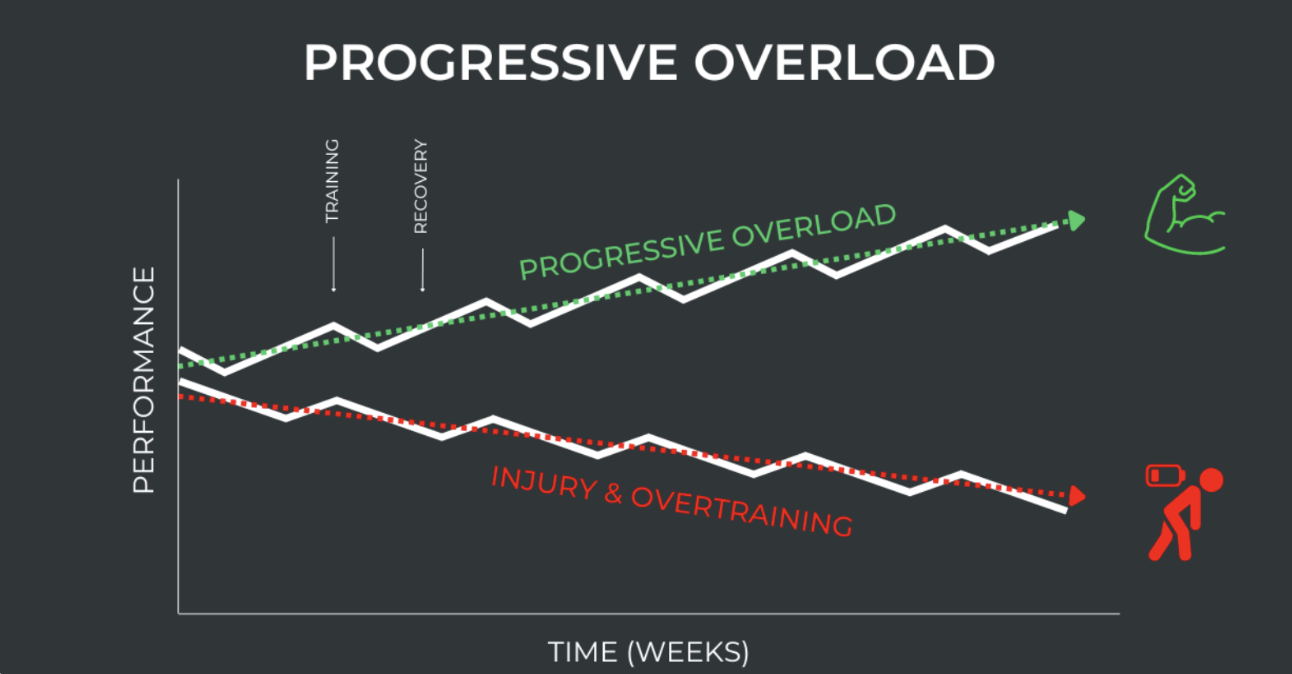
In-Depth Exploration 2: Progressive Overload, How to Keep the Engine of Muscle Growth Running
If I had to name the most fundamental principle of muscle growth, it would undoubtedly be 'progressive overload.' Our bodies are very smart and quickly adapt to the same stimulus. If you work out with the same weight and repetitions as yesterday, your body thinks, 'I can handle this, so I don't need to grow any more.' Therefore, to keep muscles growing, you need to continuously present them with challenges that are 'a little harder' than before.
Many people think of progressive overload simply as 'increasing weight,' but there are many different methods.
Increasing Weight (Intensity): This is the most representative method. If you can lift a weight for 8 reps and then increase it to a weight you can lift for 10 reps, aim to lift that new weight for 8 reps next time.
Increasing Reps: If you completed one more rep with the same weight than last week, that is also a great form of progressive overload.
Increasing Sets (Volume): If you did the same weight and reps but added one more set compared to last week, then your total workout volume has increased, giving your muscles a reason to grow.
Decreasing Rest Time: Gradually reducing rest time between sets is also a good way to increase workout intensity.
What's important is to 'record' all of this. Knowing what you did last week allows you to plan what you need to do 'more' this week. Consistent recording and progressive overload are the key fuels that keep the engine of muscle growth running.
Episode: Office Worker Lee Ji-eun's Workout Journal
Office worker Lee Ji-eun, who was experiencing a workout plateau, bought a small notebook and started recording her workouts. "Today, I successfully did 3 sets of bench presses at 20kg for 8 reps. Next week, I’ll aim for 10 reps!" By challenging herself with small goals each week, her workout ability significantly improved after a few months. "The workout journal wasn't just a record; it was the clearest map showing my growth."
Nutrition and Rest (FAQ)
Q. How much protein should I eat in a day?
If your goal is muscle growth, it's advisable to consume at least 1.6g of protein per kg of body weight daily. For example, if you weigh 70kg, aim for over 112g of protein each day. Distributing this intake over 3-5 meals is more effective for absorption.
Q. Do I have to take creatine?
It's not essential, but it's one of the most researched supplements in terms of effectiveness and safety. Creatine helps with strength during high-intensity workouts, which can lead to greater workout volume and positively impact muscle growth. A typical intake is around 3-5g daily.
Q. Is it good to work out every day?
No, rest is just as important as exercise. Muscles grow not when you're working out, but when you're 'resting.' It's advisable to give at least 48 hours of recovery time to the muscles you've worked. That's why a split routine for upper and lower body is beneficial.
Author Information: The content of this article is based on a meta-analysis of resistance training published in reputable journals (volume, weight, rest, failure point), the official stance on protein and creatine from the International Society of Sports Nutrition (ISSN), and the latest research on sleep and muscle recovery, providing an objective summary of the core principles of muscle growth.




Comments
Post a Comment